

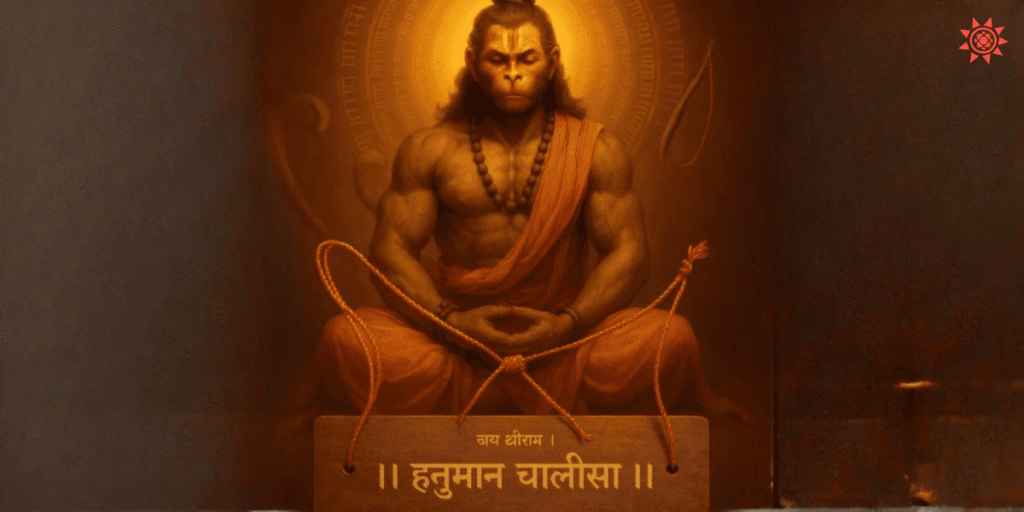
Hanuman Chalisa is a sacred hymn of 40 lines, written in the Awadhi language, in praise of Lord Hanuman, the godly servant of Lord Ram. It is one of the most revered and potent mantras in Hinduism and is read daily by millions to seek protection, strength, courage, and divine blessings. Every line of the Hanuman Chalisa celebrates the power, courage, faith, and service of Lord Hanuman towards Lord Ram. It is used to eliminate fear, solve complex issues, and provide peace and positivity in our lives.
Bring home the sacred Hanuman Chalisa and invite Lord Hanuman’s strength and protection into your life.
Order now and begin your daily devotion with faith.
Who Composed the Hanuman Chalisa?
The Hanuman Chalisa was composed by Goswami Tulsidas, a 16th-century Hindu saint, poet, and philosopher. Tulsidas ji is also the legendary author of the Ramcharitmanas, a poetic
retelling of Valmiki’s Ramayana in Awadhi.
Who was Tulsidas ji?
Tulsidas ji (1532–1623 CE) was an ardent believer in Lord Ram. Born in Rajapur, Uttar Pradesh,
India, he became an orphan in childhood but was raised with a strong leaning towards
spirituality and the study of Sanskrit scriptures. Tulsidas ji was a saint-poet whose faith in Ram
remained unbreakable.
Hanuman Chalisa Origin Story:
The Hanuman Chalisa was written by Tulsidas ji in the 16th century while living in Varanasi. One of the most amazing and widely known stories about the creation of this divine hymn is the “monkey protection story,” which serves to wonderfully describe Hanuman’s divine grace towards his devotee.
The Monkey Army That Guarded Tulsidas ji
At a time in the 16th century, Tulsidas ji was accused of having used spiritual powers to entice people and was arrested by the Mughal emperor (some accounts state Emperor Aurangzeb). When Tulsidas ji was incarcerated in Delhi or Varanasi (accounts differ), he started praying intensely to Lord Hanuman, his ishta devata (personal deity). At this time of hardship and anxiety, he wrote and recited the Hanuman Chalisa with great devotion.
As an answer to his prayers, a strange army of aggressive monkeys emerged suddenly and stormed the royal palace and caused panic and terror. The monkeys leveled everything in their way, and no one among the soldiers could halt their advance. Seeing this heavenly phenomenon, the emperor was filled with fear and inquired about the cause of this unusual phenomenon.
It was only then that it was discovered that these monkeys were on a mission from Lord Hanuman to guard his devotee Tulsidas ji. Recognizing the divine strength standing behind Tulsidas ji, the king not only set him free but also apologized to the saint. Thereafter, Hanuman Chalisa became revered not only as a devotional song but also as a magic stotra capable of calling upon Hanuman’s direct intervention in case of need.
Hanuman Chalisa Origin Story: Tulsidas’ Divine Encounter, Miracles, and Eternal Devotion
The Hanuman Chalisa was written by Tulsidas ji in the 16th century while living in Varanasi. One of the most amazing and widely known stories about the creation of this divine hymn is the “monkey protection story,” which serves to wonderfully describe Hanuman’s divine grace towards his devotee.
The Monkey Army Story
At a time in the 16th century, Tulsidas ji was accused of having used spiritual powers to entice people and was arrested by the Mughal emperor (some accounts state Emperor Aurangzeb). When Tulsidas ji was incarcerated in Delhi or Varanasi (accounts differ), he started praying intensely to Lord Hanuman, his ishta devata (personal deity).
At this time of hardship and anxiety, he wrote and recited the Hanuman Chalisa with great devotion. As an answer to his prayers, a strange army of aggressive monkeys emerged suddenly and stormed the royal palace and caused panic and terror. The monkeys leveled everything in their way, and no one among the soldiers could halt their advance. Seeing this heavenly phenomenon, the emperor was filled with fear and inquired about the cause of this unusual phenomenon.
It was only then that it was discovered that these monkeys were on a mission from Lord Hanuman to guard his devotee, Tulsidas ji. Recognizing the divine strength standing behind Tulsidas ji, the king not only set him free but also apologized to the saint. Thereafter, Hanuman Chalisa became revered not only as a devotional song, but as a magic stotra capable of calling upon Hanuman’s direct intervention in case of need.
Why did Tulsidas ji compose the Hanuman Chalisa?
1. Devotion to Hanuman: Tulsidas ji was an ardent devotee of both Lord Ram and Lord Hanuman. He composed the Hanuman Chalisa to sing the praises of Hanuman’s divine qualities.
2. Protection & Strength: The Chalisa was written as a spiritual weapon for inner vigor to guard devotees against evil forces and negative energies.
3. To Popularize Bhakti (Devotion): By writing it in a vernacular language the common folk could read, Tulsidas ji brought devotion and spiritual insight to everyone.
4. Personal Experience: According to some traditions, Tulsidas ji dreamt of or was seen by Hanuman and was inspired to write the hymn as a direct result of divine grace.
People read the Hanuman Chalisa for many spiritual and personal reasons. It is believed to remove fear, destroy negative energies, and protect from evil influences. It gives mental strength, courage, and peace during difficult times. Devotees recite it to seek Lord Hanuman’s blessings for health, success, and spiritual growth. The Hanuman Chalisa is also a symbol of deep devotion (bhakti), written in simple language so everyone can connect with Lord Hanuman’s divine power.
Conclusion
The Hanuman Chalisa is not only a prayer hymn but also a spiritual manual for courage, belief, and power. Composed by Tulsidas ji, a saint with profound dedication to Lord Ram and Hanuman, this sacred prayer still inspires millions even after centuries. Whether sung in temples, homes, or hearts, the Hanuman Chalisa is an eternal fountainhead of divine power and inspiration.
Start your spiritual journey with the powerful Hanuman Chalisa.
Buy your copy today and experience courage, peace, and divine blessings.
